.png)
.png)



MindSync builds it from your week: questions to ask, open to-dos, the threads you keep pulling on and recent realizations. You start with what matters, not with 'so, how was your week?'

With your therapist's OK. You get a summary card with the questions your therapist asked, your to-dos, threads and realizations.

Do it while it's fresh. After 3 sessions, your After therapy card adds Your progress in therapy, a chart built from your own entries.

Voice notes, check-ins on your focus areas, habits, and Orca, your therapy assistant, who helps you think things through. Everything lands in your Workspace, ready for next time.
Next-session agenda, to-dos, questions, goals, threads and realizations, in one place instead of scattered notes.

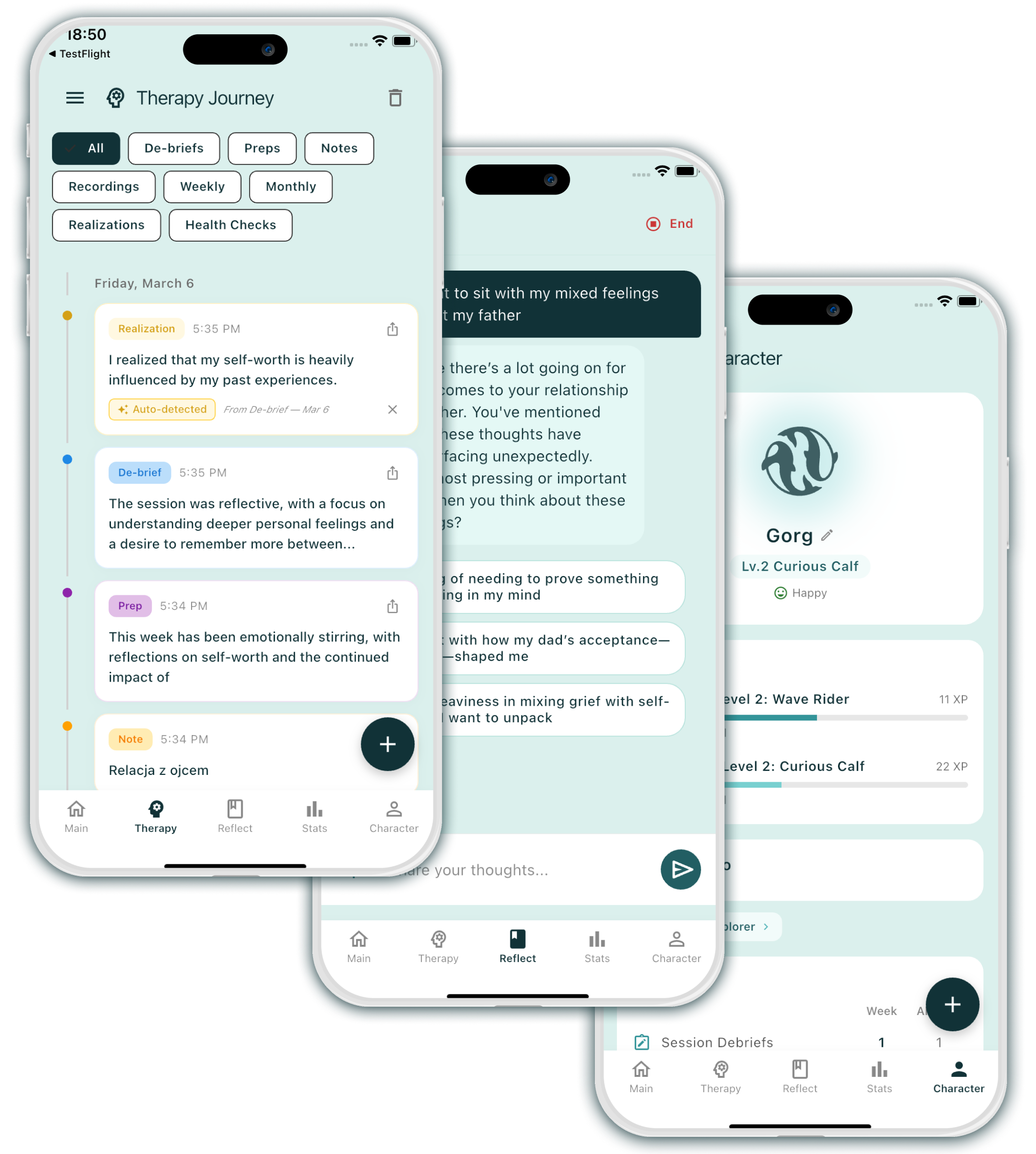
Sessions, voice notes, check-ins and realizations, with filters. Search it before your appointment instead of your memory.

Pick your focus areas, rate them in under a minute, and see your last 14 ratings with the trend in plain words.


Record the session and get a summary card you can come back to.
Open your agenda instead. MindSync builds it from your week before every session.
Note what you took away while it's fresh, and let Orca ask the follow-up questions.

Most journals don't know you have a therapist. MindSync is organized around your appointments: before, during, after and the days in between.

No ads, nothing sold, never used for marketing. Nothing reaches your therapist unless you send it, and you can make Orca forget everything.
General chatbots tend to agree with you. Orca, your therapy assistant, asks the follow-up question instead. Orca isn't a therapist, and it says so.

Bring your agenda instead of spending the start of the session on a recap.

Therapy homework becomes a to-do on your home screen, so it shows up on Tuesday, not in the waiting room.

Ratings over weeks show what moves your baseline and what does nothing.
Send a summary by email or WhatsApp, share a card as an image, or just show your phone. No therapist account needed.


In 10 years of therapy, I kept forgetting what we talked about by Thursday. MindSync is the tool I wanted for the days in between.
Darek, MindSync founder
It does a good job of turning your own thoughts back on you, so you really have to think through how you're feeling about any given topic.
Makes me feel so much more organized about my overall mental health rather than it all being in different places.
I'm recovering from burnout. This app helped me see the patterns between my mood and what I was actually doing. That's something a generic chatbot can't do.
I have had some very helpful breakthrough conversations to carry forward to the therapist.

Pick the areas you're working on and rate them from 1 to 10, in under a minute. MindSync charts your last 14 ratings and describes the trend in plain words. Your weekly summary pulls your notes, check-ins and sessions into one short read.
Good therapy digs deeper. MindSync doesn't tell you what to do or agree with everything you say. It helps you explore. The questions surface blind spots and patterns you might miss on your own. Reflection with structure, not therapy with a chatbot.
No. Your data is encrypted. We don't sell it. We don't share it. It's yours.
Yes, and you decide what goes. There is no therapist account or portal in MindSync, so nothing reaches your therapist unless you send it. Share your weekly or monthly summary by email or WhatsApp, share a single card as an image, or just bring your phone to the session.
MindSync is your tool. Some therapists like a summary, others prefer to work without one. Nothing reaches them unless you send it. We talked to many therapists while building MindSync, and the app is designed to support your therapy, not to replace it.
No. MindSync is a therapy support tool. It captures what matters, surfaces patterns, and prepares you for better conversations. We support therapy. We never replace it.
You can still use MindSync to reflect on your mental health and spot patterns. When you're ready to start therapy, you'll have data that makes that first conversation easier.
After about 14 check-ins you'll see a trend for each focus area. After 3 sessions, your After therapy card adds Your progress in therapy.
Only with your therapist's permission. Ask at the start, record in MindSync, and get a summary card afterwards. The free plan includes 2 recordings to try it.
The free plan is free forever, with monthly limits. Premium is $14.99 a month or $144.99 a year, with no limits. Every account starts with 4 days of Premium, no card.
No. MindSync is not a crisis service and not a substitute for emergency care. If you're in crisis, contact local emergency services. In the US, call or text 988.