
Therapy
How to Identify Your Emotional Triggers (Without Turning It Into Homework)

Someone says the dishwasher was loaded wrong. Four seconds later your face is hot, your voice has an edge you did not choose, and some part of you is already watching from a distance, wondering why a plate is doing this. The reaction did not match the comment. It rarely does.
A trigger is not the thing that annoyed you
An emotional trigger is a cue that sets off a reaction bigger than the situation in front of you. The cue is usually small: a tone, a word, a look away. What it connects to is older, which is why the size of the reaction feels wrong to you afterwards.
Most advice on how to identify your emotional triggers stops at "notice your patterns". That is a bit like being told to notice your own blind spot. The pattern is made of moments you were not thinking clearly in, and by the evening you have already tidied them up.
So "what annoyed me" is the wrong question to open with. Your housemate said 11 words about a plate. Someone else in the room heard the same 11 words and reached for the salad. Same comment, different landing site, and the landing site is what you are after.
Worth saying early: this is about ordinary reactions, the ones that leave you apologizing at 9 p.m.. Plenty of people arrive at this topic through heavier doors. If that is you, the capture habit still helps, but the interpretation belongs in a room with your therapist and not in a note on your phone.
Your body notices first
By the time you have a word for what happened, your body has been at it for several seconds. Jaw. Shoulders. A breath that has moved higher in your chest, heat across the face, the urge to leave the room or to win the argument.
There is a striking lab version of this. Ohman and Soares (1994, Journal of Abnormal Psychology) showed snake-fearful and spider-fearful volunteers images so briefly, and masked so thoroughly, that the volunteers could not say what they had seen. Their skin conductance responses arrived anyway, as strong as when the picture was fully visible. Read that carefully, though. It was a study of specific phobias under controlled conditions, and it does not prove your kitchen argument runs the same circuit. It still makes one practical point hard to dodge. Physiology can be underway before recognition catches up.
Which is useful, because the body signal is the earliest thing you can actually catch. Nobody notices "I am being triggered" in real time. You notice your jaw. Treat that as the cue to write something down.
If you are still wound up hours later, capture is not the job. Settle the body first, then look at the pattern, because nothing you write while your heart is still going will be worth reading back.
The five-second capture
The standard CBT worksheet has four columns: situation, automatic thought, emotion, behavior. It runs through every edition of Judith Beck's Cognitive Behavior Therapy: Basics and Beyond (third edition, 2020), and it works beautifully in a therapist's office with a pen and 20 minutes.
It does not work standing in a kitchen with your heart going. So shrink it. Five fields, one line each, thumbs on a phone, finished before you have decided whether to be embarrassed.
Situation
Where you were, who was there, what was said. Use the actual words if you have them. "He said I loaded the dishwasher wrong" is a situation. "He was being critical again" is already an interpretation, and interpretations belong two fields down.
Body
The first physical thing you noticed, and where. Chest, jaw, stomach, hands, heat, cold. One word is enough. This field will teach you the most over a month, because your body stays more consistent than your explanations do.
Thought
The sentence that ran through your head, in the words it actually used. Not the reasonable version you would say out loud. If the sentence was "she thinks I am useless", write that, ugly grammar and all.
What you did
Snapped, went quiet, left the room, opened your phone, over-apologized, made a joke, poured a drink. No judgment attached. Just the verb.
What it cost
This is the field almost nobody fills in, and the one that makes a month of notes readable. A silent 20 minutes. An evening. A conversation you then had to repair. Sleep. Sometimes the honest answer is "nothing", which is information too, because not every spike is expensive and knowing which ones are keeps you from treating all of them as emergencies.
Naming things as you write them does something on its own. Lieberman and colleagues (2007, Psychological Science) found that putting a label on negative images reduced amygdala response and raised activity in the right ventrolateral prefrontal cortex, the region involved in thinking about feelings in words. Kircanski, Lieberman and Craske took it out of the scanner in 2012, also in Psychological Science: spider-fearful people who described their fear in words during exposure showed lower skin conductance a week later than people who used distraction or reappraisal, and the more emotion words someone used, the bigger the difference.
Lieberman's own group is careful about this. Torre and Lieberman's 2018 review in Emotion Review says outright that the picture of how and why affect labeling works is still at an early stage. So it is a mechanism worth having on your side rather than a technique that makes the feeling go away.
Precision helps. Barrett, Gross, Christensen and Benvenuto (2001, Cognition and Emotion) found that people who described their negative feelings in more differentiated terms used regulation strategies more often, particularly when the feeling was intense. "Dismissed" beats "bad". "Cornered" beats "upset". If the specific word will not come, write the vague one and move on. A captured vague note is worth more than a precise one you never wrote.
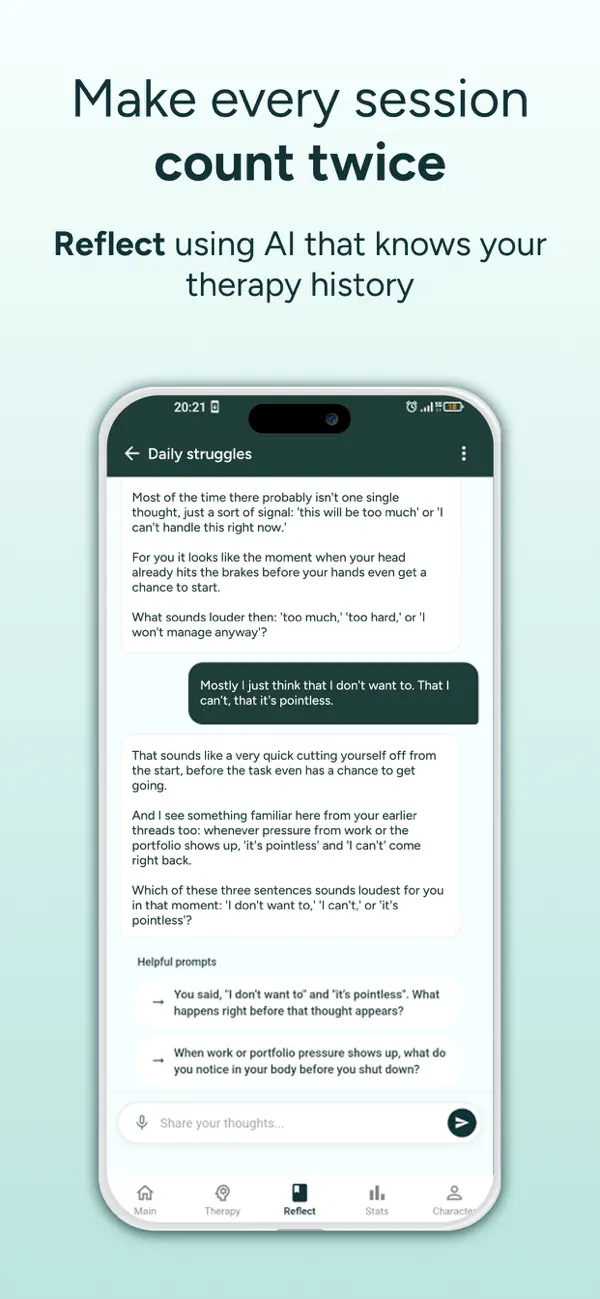
Reflect (AI journaling)
When something sets you off, Reflect asks the follow-up questions a blank note never will, in text or out loud. Try it free in MindSync →
Why writing it later does not work
Sunday night, tea, good intentions, and you sit down to write about your week. What comes out is "work has been stressful and I have been snappy". Probably true, and no use at all for finding a trigger.
Robinson and Clore described the mechanism in a 2002 review in Psychological Bulletin. Reporting on a feeling right now draws on the episode itself. Reporting on a longer stretch of time runs out of episodic detail, so people switch over to semantic memory, meaning what they believe about themselves in general. The longer the gap, the more your report describes your self-image instead of Tuesday at 7:40 p.m.
Researchers built ecological momentary assessment for this reason, sampling people in their own environments as things happen. The 2008 review by Shiffman, Stone and Hufford in the Annual Review of Clinical Psychology lays out the case plainly: global retrospective self-report carries recall bias, and in-the-moment sampling exists to cut it.
In the moment does not mean mid-argument. Excusing yourself to type notes about someone while they stand there is its own event, with its own cost. The window is the first few minutes after, in the car or on the walk back to your desk, before you have started explaining yourself to yourself.
What to do with a month of these
Say you have 20 or 30 entries. Reading them one at a time will tell you what you already knew, which is that you have had a rough month. The value is in the sorting.
Group by situation, not by emotion
Sorting by feeling gives you a pile labeled "angry" containing six unrelated events. Sort by setting instead: who was there, what was being asked of you, what time it was. Then look for the repeat. Being corrected in front of someone. Being asked to decide quickly. Being left on read. Patterns live in contexts, while an adjective only tells you the evening went badly.
Look for the sentence underneath
Read the Thought field across all of them in one sitting. It repeats in different costumes. "He thinks I am careless." "They think I do not know what I am doing." "She is going to work out that I am winging it." Underneath five phrasings there is usually one sentence, older than any of the incidents. That sentence is what people are reaching for when they say they want to understand the behavioural patterns underneath.
No app finds that sentence for you, ours included. Spotting it is human work, and the entries are what give you something to spot it in.
Bring the pattern to your therapist, not the incident
Spending 15 minutes retelling the dishwasher story produces a session about dishwashers. "Nine times in five weeks, seven of them involve being corrected in front of someone, and the sentence is always some version of they think I am careless" produces a different session. Hand over the summary and the two entries that were hardest to write, not the whole pile. Your therapist may take it somewhere you did not expect, which is rather the point of them. It belongs near the top of your list when you bring the pattern to your next session.
Mood & focus-area trends
A month of entries next to your ratings, so the pattern shows up as a shape instead of a suspicion. Try it free in MindSync →
None of this requires an app. A notes file with five headings does the job, and plenty of people run it that way for years. What an app changes is friction and retrieval: how fast you get the five fields down at 7:41 p.m., and whether you can find all nine entries five weeks later without scrolling past your grocery lists. That second half is what MindSync was built to answer. The rest of what the app does grew out of the same problem.
From incident to pattern
- Wellbeing check-ins - A one-minute rating of the areas you are working on, so you can see whether a bad moment landed in an otherwise ordinary week.
- Workspace - The realizations worth keeping, plus the agenda for your next session, in one place.
- Personal bio & companion - A running picture of you written from your own entries, worth reading next to the patterns you spotted yourself.
Frequently asked questions
What are emotional triggers?
An emotional trigger is a cue that sets off a reaction bigger than the situation calls for. It can be a tone of voice, a phrase, a smell, a time of year. The reaction is real, and the mismatch between cue and reaction is the signal. Triggers are ordinary and everybody has them, which is a different claim from saying each one points to trauma.
Why do I overreact to small things?
Usually because the small thing is standing in for something that is not small. Your body responds to the cue before you have interpreted the situation, so the reaction arrives already at full size. Tiredness, hunger and a hard week lower the threshold. If it keeps happening in one particular setting, that setting is the thing worth writing down.
How do I know if it is a trigger or just a bad mood?
A bad mood colors everything fairly evenly. A trigger is specific: fine at 6 p.m., not fine at 6:04 p.m. after one sentence. The test is repetition. A single incident tells you very little. If the same kind of moment sets off the same reaction three or four times over a few weeks, you are looking at a trigger rather than a mood.
Can you get rid of a trigger?
Not by deciding to, generally. What tends to change is the gap between the cue and what you do next: you catch it earlier, and the reaction reaches less far. That shift is slow, and it is the kind of work therapy is built for. Being able to describe your own reactions specifically gives your therapist something concrete to work with.
How long does it take to spot a pattern?
Expect a few weeks. Patterns need repeats, and repeats need calendar time rather than effort. Eight notes written in the moment beat a month of Sunday night reconstructions. If nothing has repeated after six weeks or so, that is worth mentioning to your therapist too, because it may mean you are catching the wrong moments.
Keep more from every session
MindSync keeps your sessions and the week between them in one place, so your progress stops slipping away. The trial is free, no credit card needed.


Get the app