
Therapy
Why Mood Tracking Stops Working After Two Weeks

Seventeen days in a row. Then a Thursday you forgot, then a weekend you did not bother, and by the following Tuesday the app was off your phone. That is the standard arc, and it is not a discipline problem. You quit because nothing was ever going to happen with those numbers.
Three reasons tracking dies
Mood tracking almost never fails on day one. It fails somewhere in week two or three, once the novelty is gone and the effort is not. Three things are usually going on, and only one of them is about willpower.
You tracked a number nobody was going to read
Logging takes ten seconds. Reading takes an evening, and nobody ever scheduled that evening. So the entries stack up inside an app you open less and less, and the whole ritual starts to feel like filing paperwork for an office that closed.
Researchers found the same gap when they asked people directly. In a 2021 interview study in JMIR Mental Health, Schueller, Neary, Lai and Epstein spoke with 22 people who used mood-tracking apps in ordinary life. Nine of them said they struggled to interpret what they had collected. One described it as getting confirmation that they felt bad, with no help doing anything about it. The authors put the gap plainly: the apps offered almost no support for making sense of your own data.
You tracked too much
A form with 15 sliders is a survey. On a good day you fill it in. On a bad day, which is the day the data would actually be worth something, you skip it, and then you skip it again because the run is already broken.
A 2025 systematic review and meta-synthesis in npj Digital Medicine by Astill Wright and colleagues pooled 14 qualitative studies covering 457 people who monitored their mood for research or treatment. Nine of those papers reported trouble simply completing the questionnaires. Items felt repetitive. The response options felt too closed to describe anything real. One participant said that during a low stretch, getting out of bed to fill in the forms was "nigh on impossible." So the design collapses on exactly the days that matter most.
You tracked the wrong thing
"Mood, 1 to 10" is a strange quantity to measure. It flattens a morning of dread and an afternoon of relief into a six, and it answers a question you were not really asking.
You are probably in therapy for something more specific than mood. Sleep that collapses on Sunday nights. The tightness before a meeting. The way you go quiet with your partner instead of saying the thing. A general mood score averages all of that away. One participant in the npj Digital Medicine review said it better than most research papers manage: "I like recording what keeps me well, not what makes me ill."
What the research actually says
Two findings, and they pull in different directions.
Quitting is the norm. Baumel, Muench, Edan and Kane analyzed real usage panel data across 93 mental health apps in a 2019 paper in the Journal of Medical Internet Research. The median app held on to 3.9% of installed users at 15 days and 3.3% at 30 days, with a median daily open rate of 4.0%. Whatever you decided about yourself when you deleted it, you had plenty of company.
Then there is the harder question, and the same team went after it. In 2026 in JMIR Mental Health, Astill Wright and colleagues published a meta-analysis of eight randomized controlled trials with 1,230 participants. In depression, monitoring was linked to a small drop in symptoms at 12 months, although that number comes from the two trials that followed people that long, 262 participants between them, rather than from the full 1,230. It only just touched statistical significance (standardized mean difference -0.25, 95% confidence interval -0.49 to 0.00). In bipolar disorder they found nothing in either direction.
The honest caveat: every trial in that analysis bundled monitoring with something else, whether a nurse reviewing the results, psychoeducation or CBT modules. Nobody has cleanly tested logging on its own, and the authors' own conclusion was that the evidence is not strong enough to claim benefit or harm from monitoring by itself.
Read that as permission rather than bad news. Tracking is not the treatment. It is the raw material for something else, usually a conversation or a decision, and when that something else does not exist, the habit has nothing holding it up.
Two mechanisms underneath all this are better established. Self-monitoring is reactive: the act of measuring a behavior tends to change it, which Korotitsch and Nelson-Gray documented in their 1999 review in Psychological Assessment. And naming a feeling is not the same as ticking a box for it. Lieberman and colleagues found in 2007 in Psychological Science that labeling an emotion dampened amygdala response to unpleasant images. That is a mechanism seen in a scanner, not a promise about your Tuesday.
When tracking makes things worse
Skip this part and the rest is dishonest. In that npj Digital Medicine review, negative psychological effects came out as one of seven overarching themes, not a footnote. People described the results as confronting when the numbers disagreed with how they thought they felt. Some developed a compulsive relationship with the device. Some ruminated after logging a low mood, still worrying about it long after the entry was saved. Several called the regular reflection an unwelcome reminder of their depression.
The practical version: if logging leaves you more preoccupied with the symptom than you were before, say that out loud to your therapist instead of pushing through. Cut back to one marker, or stop for a few weeks. Nothing about your therapy depends on you filling in a form.
A version that survives
Make the entry smaller than your resistance, and turn the reading into a real appointment. The rest is detail.
Under a minute, same moment every day
Attach it to something that already happens: the kettle, the commute, the moment you put your phone on the charger. A cue works better than a clock, because your evenings are not identical and your willpower at 10pm is not a reliable partner. If it takes longer than a minute, you will skip it on the day you most need it.
Three markers maximum
Pick two or three things you are genuinely working on and name them in your own words. Sleep, maybe. How anxious you were before work. How much you avoided. You can change the list later, just not every week: a marker only becomes useful once you have a few weeks of it behind you.
Wellbeing check-ins
Rate the two or three areas you are actually working on, in under a minute, and the trend line builds itself. Try it free in MindSync →
One reading session a week
Put 15 minutes in the calendar on the same day each week and actually look at what you wrote. Almost everybody skips this step, and it is the one that turns a chore into information. Two questions are usually enough: what moved, and what surprised you.
A reason to look back
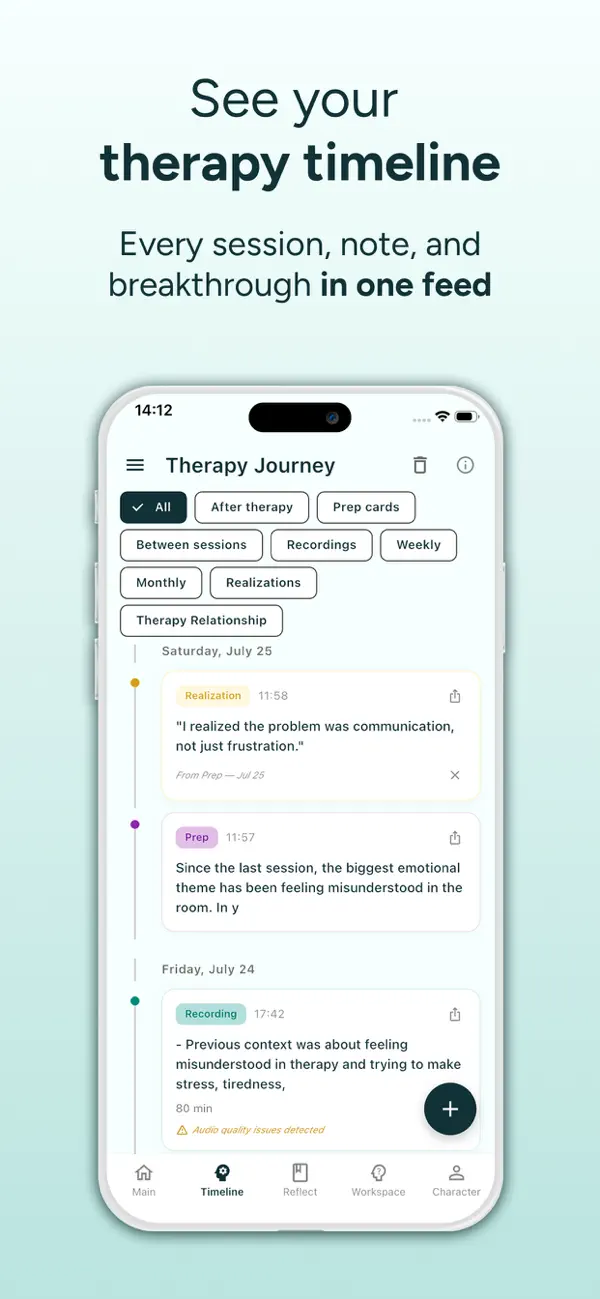
The most durable reason is the next session. If your notes get read out loud on Thursday, Monday's entry has a job to do. So give the log a reader. That does more for consistency than any amount of resolve on a Sunday night.
What a month of data can tell you (and what it cannot)
A month is enough to see shape. Whether the bad days cluster around particular days of the week. Whether one marker moved while the others sat still. Whether the thing you were sure was getting worse has been flat since week two. Those are good things to walk into a session holding.
A month cannot tell you why. Your numbers lifted in a month that also contained a holiday, better weather, a medication change and a fight you finally resolved. Tracking generates hypotheses; testing them is a separate job, and testing one thing at a time is how you find out whether the breathing exercise did anything. Reading the pattern underneath the ratings is another job again: how to spot the triggers underneath the numbers.
A month of ratings also is not a verdict on your therapy. That question needs its own method, which is a longer conversation about how to know if therapy is working.
Weekly & monthly summaries
A weekly summary reads the entries back to you, which is the step most tracking apps skip. Try it free in MindSync →
One thing worth settling before you start again: know where your entries are stored and who can reach them. It is easier to be honest in a log once that question has an answer.
Tracking that survives month two
- Wellbeing check-ins - Under a minute, only the areas that matter to you.
- Mood & focus-area trends - The picture, not the pile of entries.
- Reminders you control - A nudge at the moment that fits your week, and a switch to turn it off.
Frequently asked questions
Does mood tracking actually work?
It works when three conditions hold: the entry takes under a minute, you track a few specific things instead of general mood, and somebody reads the result, whether that is you on a set day each week or your therapist in the next session. Trials of monitoring bundled with therapeutic support show small effects at best, and monitoring on its own has never been cleanly tested.
How often should I track my mood?
Once a day, at the same cue, is enough for most people working on something in therapy. Several times a day gives you finer detail and a much higher chance of quitting. If daily already feels heavy, drop to three fixed days a week. A sparse record you keep beats a dense one you abandon in week two.
What should I track instead of mood?
Track the two or three things you are actually working on. Sleep quality, anxiety before a specific situation, how much you avoided, how often you spoke up, energy in the afternoon. Name them in your own language rather than clinical language. Specific markers move visibly and tell you something. A general mood score mostly averages your week into a shrug.
Why do I keep forgetting to log my mood?
Usually because the entry is not attached to anything. A reminder at 8pm competes with your entire evening, while a cue you already perform, like making tea or plugging in your phone, does not have to compete at all. Forgetting is also a signal worth reading: if a one-minute task keeps slipping, the task is probably still too big.
What do I do with all this mood data?
Read it once a week and bring the shape of it, not the raw numbers, to your next session. Look for clustering, for one marker moving while the others stay flat, and for anything that contradicts the story you have been telling yourself. Then pick one question out of that and test it deliberately over the next two weeks.
Keep more from every session
MindSync keeps your sessions and the week between them in one place, so your progress stops slipping away. The trial is free, no credit card needed.


Get the app